By Patrick Pike


Flooding
Presidential election 1974. René Dumont, environmentalist candidate, theatrically announces a global water shortage by drinking a glass of the precious liquid on TV. She will be missing by the end of the century, predicts this Trissotin, imagining himself Cassandra. More likely a Gaudissart-style huckster.
Eight years later and a few medium and successive floods later, the flood of the century, as it was called, while that of 1904 was much more significant, submerged the town of Saintes. In January 1982, a first rise in water levels to 5.58 m had already raised fears of the worst. In December of that same year the level will be exceeded by more than a meter. The winter rains having been continuous for a fortnight after two episodes of intense downpours(1) associated with slow kinetics due to its low altitude, the river overflowed. The waterlogged earth no longer absorbs. The downstream of the river cannot be enough to dump this overflow into the ocean. The Charente spreads over the plains of Angoumois and Saintonge, floods houses, cuts off roads, frightens local residents forcing them to seek refuge on the heights of stigmatized towns, isolates hamlets, drowns buildings, ravages vines. But even more serious, the torrential rains that poured over the ancient provinces caused rivers and streams to overflow one after the other, thus drowning the entire Charente basin. Both departments are under water. This is why the flood of 1982 was that of the century.
The Charente can also take pleasure in this biblical state comparable to the deluge where we see firefighters and other rescuers imitating Noah in makeshift boats, as in 2018 when the flood lasted four to five weeks despite a rating barely exceeding 5 Mr.
Other places were thus devastated, before or after, by the same phenomenon, in the four corners of the world, rivers, rivers and streams not knowing the measure, like the Garonne in Toulouse or in Bordeaux, the Seine in Paris , the Rhône, the Loire, the Lot, the Adour, the Isle, the Dordogne, the coastal watercourses of the North or those of the South, others still as far as France is concerned, but with more than violence, as in October in the Valley of La Roya, a more murderous river than the Charente, of which François 1er said that it was the gentlest river in his kingdom, Charente which has this particularity in that its floods are both slow to rise and ‘to come back down and do not cause any deaths. Generous, she gives her victims time to escape the grip of her sprawling spread out of bed.
If it is slow, in return it also knows how to impose its power. The December 1982 rating reached 6.84 m. In 1994, slight drop to 6.67 m. That of this year will reach its peak around 6.30 m. It’s better than pole vaulters, but not as good as the previous floods, that of the beginning of the last century, whose mark engraved on the pillar of a railway bridge along the river proudly announces that it holds still the record at 7.25m. Noting that their guru has effectively erred in his predictions with the same authority as a Malthus, these ecologists who emulate Dumont, who have become as numerous as a virus infecting a cell, now stupidly incriminate the action of climate change as the alpha and omega in the occurrence of all disasters. Even if it means contradicting themselves, they make one reason succeed another, according to their deductions of the moment, denouncing however as a leitmotif since the prophecies of the Anglican priest human responsibility.
But the scenario repeats itself, here as elsewhere, for millennia, with or without human presence, even if sometimes the latter is at the origin of error due to its stupidity. As proof of this reiteration, among others, from the epic of Gilgamesh to biblical Genesis and various other religions where it is mentioned, the flood created by spirits with overflowing imaginations that catastrophic floods will have shocked, or, more significant because visible and still used today, the roadway (2) almost a kilometer long, intelligently built by the Romans, redeveloped and reworked since the 12th century until today, around Saintes near Taillebourg, which still allows you to cross the flooded plain adjoining the river, while our pretentious engineers, like Dumont, have only known how to stony, then tarmac, at the foot of this roadway, a path regularly impassable because of the water marshes, even when the river, exceptionally, does not overflow.
Probably by believing in improbable droughts in our regions.
Some photos taken from Christian Genet
1 – https://journals.openedition.org/physio-geo/8942
2 – https://www.portdenvaux.fr/la-chaussee-romaine/
07/09/2023
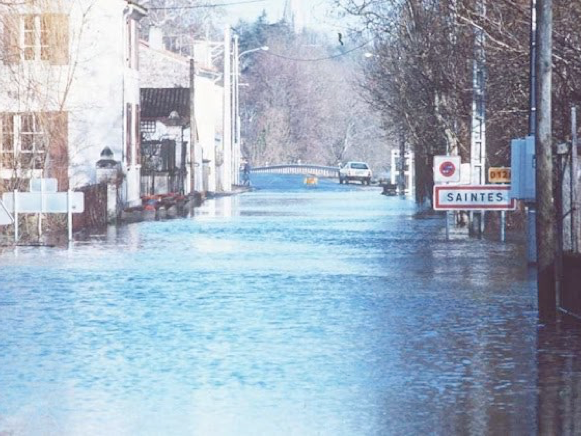
December 1982 Charente flood – Photo Sud-Ouest


Le Plumier© 2023 Patrick Pike